

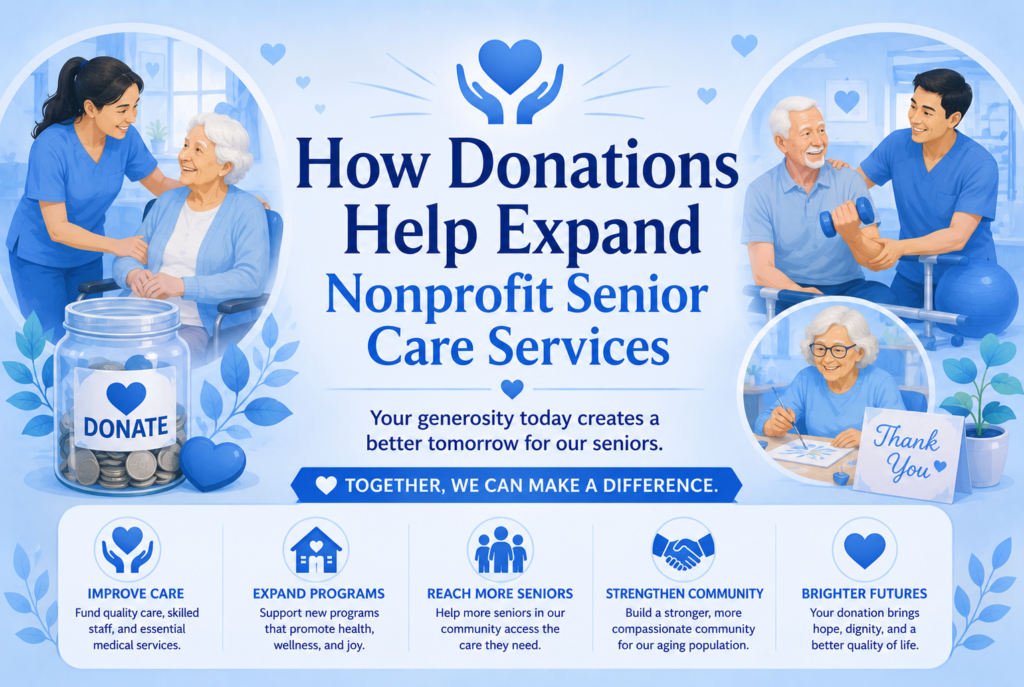
 As the number of older adults continues to grow, communities need accessible, compassionate, and high-quality senior care services. Nonprofit senior care organizations play an important role in meeting this need by providing services designed around the dignity, safety, health, and quality of life of older adults.
However, providing comprehensive senior care requires more than dedicated caregivers and professional expertise. Financial support from donors can help nonprofit senior care organizations strengthen programs, improve services, support residents and families, and respond to changing needs in the community.
Donations can become an important source of support for organizations serving older adults. Contributions may help nonprofits invest in programs and resources that complement the care provided every day.
For families considering nonprofit senior care, understanding the role of charitable giving can provide valuable insight into how these organizations contribute to the broader community.
Why Nonprofit Senior Care Services Matter
Nonprofit senior care organizations are often established with a mission that extends beyond operating a residential care community. Their focus may include providing compassionate care, supporting older adults and their families, strengthening communities, and advancing better approaches to aging services.
Senior care can take many forms, including:
- Skilled nursing and rehabilitation
- Assisted living
- Long-term residential care
- Short-term recovery services
- Memory support
- Social and recreational programs
- Family support and education
- Community-based senior services
Each service requires people, facilities, equipment, programs, and ongoing resources.
Donations can provide an additional source of financial support that allows nonprofit organizations to pursue initiatives beyond the basic cost of delivering care.
How Donations Support Nonprofit Senior Care
Charitable contributions can support nonprofit senior care in several ways. The specific use of donations varies from organization to organization, but philanthropic funding can help strengthen services and expand opportunities for older adults.
1. Supporting Programs That Enhance Quality of Life
Senior care is about more than meeting medical and physical needs. Older adults also benefit from opportunities for social connection, recreation, creativity, learning, and meaningful engagement.
Donations can help nonprofit organizations develop and maintain activities and programs that encourage residents to remain socially connected and engaged.
Examples may include:
- Arts and crafts
- Music therapy and performances
- Educational activities
- Fitness and wellness programs
- Horticultural therapy and gardening
- Social gatherings
- Outings and community activities
- Intergenerational programs
- Holiday and cultural celebrations
These activities can help create a more engaging environment and give residents opportunities to pursue interests and maintain relationships.
2. Helping Improve Senior Care Facilities
A comfortable and supportive physical environment can make a meaningful difference in the daily experience of older adults.
Philanthropic support can help nonprofits invest in improvements to residential communities and common areas. Depending on an organization’s priorities, this may include improvements to activity spaces, outdoor areas, dining environments, accessibility features, or other areas designed to support residents.
A thoughtfully designed environment can encourage residents to spend time together, participate in activities, and move through their community comfortably.
3. Expanding Access to Senior Care Services
One of the challenges facing senior care is ensuring that older adults have access to appropriate services regardless of their financial circumstances.
Nonprofit organizations can have an important role in addressing gaps in senior care. Donations may help support programs that make services more accessible to individuals and families who might otherwise face significant financial challenges.
Charitable giving can therefore contribute to a broader mission of making compassionate senior care available to more people in the community.
The exact impact of a donation depends on the nonprofit’s programs, funding structure, and current priorities, but every contribution can help organizations continue pursuing their mission.
4. Supporting Staff and Professional Development
Quality senior care depends heavily on the people who provide it.
Caregivers, nurses, therapists, administrators, activities professionals, and other team members each contribute to the resident experience. Maintaining a knowledgeable and well-supported workforce is essential for delivering person-centered care.
Donations may help nonprofit organizations invest in:
- Staff education
- Professional development
- Training opportunities
- Educational resources
- Specialized programming
- Workforce support initiatives
Investing in staff can help organizations maintain the skills and knowledge necessary to address the changing needs of older adults.
5. Providing Resources for Residents
Older adults have individual preferences, interests, abilities, and needs. A person-centered approach recognizes that residents should be treated as individuals rather than simply as recipients of care.
Donations may help fund resources that support residents’ individual experiences.
For example, charitable funding could contribute to activities, equipment, educational opportunities, therapeutic programs, or other initiatives that complement everyday care.
This flexibility can be particularly valuable because resident needs can change over time.
6. Supporting Innovation in Senior Care
The senior care industry continues to evolve. Organizations are exploring new approaches to rehabilitation, dementia care, resident engagement, technology, wellness, and person-centered services.
Nonprofit organizations may use philanthropic support to explore initiatives that would be difficult to fund through operating revenue alone.
Innovation might involve testing new programming, improving resident engagement, implementing new technologies, or developing more effective approaches to supporting older adults.
Donations can give nonprofits greater flexibility to invest in ideas that may improve senior care over the long term.
7. Strengthening Community Connections
Older adults benefit when senior care communities remain connected to the communities around them.
Community partnerships can create opportunities for residents to interact with volunteers, students, families, local organizations, artists, educators, and other community members.
Donations can help nonprofit organizations facilitate these relationships by supporting community programs and engagement initiatives.
These connections can help reduce social isolation and create opportunities for residents to remain active participants in community life.
The Difference Between Nonprofit and For-Profit Senior Care
Nonprofit and for-profit senior care organizations can both provide important services to older adults. One distinction is how each type of organization approaches its financial structure and mission.
A nonprofit organization generally operates with a mission-driven focus, and its financial resources are used to support the organization’s purpose rather than distributed to private owners or shareholders.
This does not mean nonprofit senior care is free or that every nonprofit operates in the same way. Families should evaluate each organization individually, including its services, costs, quality, reputation, staffing, and approach to care.
For donors, however, supporting a nonprofit senior care organization can provide an opportunity to contribute directly to a mission focused on improving the lives of older adults.
Why Recurring Donations Can Be Valuable
One-time donations can make a meaningful contribution, but recurring gifts can provide nonprofits with a more predictable source of philanthropic support.
Monthly giving allows donors to contribute smaller amounts on a regular basis. Over time, these individual contributions can become a consistent source of funding.
Recurring donations may help nonprofit organizations plan charitable programs with greater confidence and continue supporting initiatives throughout the year.
Even relatively modest monthly gifts can contribute to a collective impact when many people participate.
How Families Can Get Involved Beyond Financial Donations
Supporting nonprofit senior care does not necessarily require a financial contribution.
Individuals can also support organizations by:
- Volunteering
- Participating in fundraising events
- Sharing information about nonprofit programs
- Donating needed items when requested
- Visiting and engaging with residents
- Supporting community events
- Encouraging others to learn about the organization’s mission
Time, attention, advocacy, and community involvement can all be valuable forms of support.
For older adults, meaningful interaction can be especially important. A conversation, shared activity, or regular visit can provide social connection and help residents remain engaged with the broader community.
How to Choose a Senior Care Nonprofit to Support
Before making a donation, prospective donors should take time to understand an organization’s mission and how it operates.
Useful questions include:
- What is the organization’s mission?
- What senior care services does it provide?
- What communities does it serve?
- What programs are supported through philanthropy?
- Does the organization explain how donations are used?
- What opportunities are available for volunteers?
- How can donors learn about the organization’s impact?
Donors should also look for clear information about the organization’s leadership, programs, financial practices, and charitable activities.
The goal is to find an organization whose mission aligns with the donor’s values and whose work creates meaningful benefits for older adults.
Supporting A.G. Rhodes and Its Mission
A.G. Rhodes has a long-standing commitment to serving older adults and supporting their quality of life.
For individuals and families who want to contribute to nonprofit senior care, charitable giving can be one way to help organizations continue serving older adults and developing programs that enrich the lives of residents.
Consider supporting A.G. Rhodes with a donation, volunteering your time, or learning more about opportunities to get involved. Your support can help strengthen nonprofit senior care and contribute to a community where older adults are treated with dignity, compassion, and respect.
The Broader Impact of Giving to Senior Care
A donation to a nonprofit senior care organization can have an impact that extends beyond the individual contribution.
When donors support programs for older adults, they can help strengthen the infrastructure surrounding senior care. They can contribute to activities that promote connection, programs that enrich daily life, resources that support caregivers, and initiatives that help organizations respond to community needs.
Philanthropy can also raise awareness about the importance of aging services.
As communities grow older, conversations about senior care become increasingly important. Supporting nonprofit organizations can help ensure that older adults remain part of those conversations.
Why Senior Care Philanthropy Matters for the Future
The need for senior care services will continue to evolve. Older adults are living longer, families are navigating increasingly complex care decisions, and communities are looking for ways to provide appropriate support throughout the aging process.
Nonprofit senior care organizations can help address these challenges by combining professional care with community-focused missions.
Donations provide an opportunity for individuals, families, businesses, and community organizations to become part of that work.
Whether a contribution supports resident activities, community programs, staff development, facility improvements, or another organizational priority, charitable giving can help nonprofit senior care organizations continue pursuing their missions.
Ultimately, supporting senior care is an investment in people. It recognizes that older adults deserve opportunities to live with dignity, remain connected to others, and receive compassionate support as their needs change.
Conclusion
Nonprofit senior care organizations provide essential services to older adults while working to create communities centered on dignity, compassion, connection, and quality of life.
Donations can help expand the work these organizations are able to accomplish. Philanthropic support may contribute to resident programs, staff development, community initiatives, facility improvements, and other efforts that strengthen senior care.
Supporting nonprofit senior care is ultimately a way to invest in older adults and the communities that care for them. Whether through financial giving, volunteering, advocacy, or personal involvement, each person has an opportunity to contribute to a stronger future for senior care.
When we support organizations dedicated to serving older adults, we help build communities where seniors can receive compassionate care, remain connected, and continue to live with dignity.
Frequently Asked Questions About Donations and Nonprofit Senior Care
How do donations help nonprofit senior care organizations?
Donations can provide financial support for programs, resident activities, facility improvements, community initiatives, staff development, and other priorities established by the nonprofit. The specific use of donations depends on each organization’s mission and current needs.
Why should I donate to a nonprofit senior care organization?
Donating can provide an opportunity to support older adults and contribute to programs designed to improve senior care and quality of life. Individuals should choose organizations whose missions and charitable practices align with their values.
Can a donation help improve the quality of life for seniors?
Yes. Philanthropic support can help fund activities, programs, resources, and community initiatives that complement everyday senior care and provide opportunities for residents to remain engaged and connected.
Are nonprofit senior care organizations different from for-profit senior care providers?
Nonprofit organizations are generally mission-driven and reinvest their resources into advancing their organizational purpose rather than distributing profits to private owners or shareholders. However, services, costs, and operating structures vary, so families should evaluate each provider individually.
Can I support senior care without making a monetary donation?
Yes. Volunteering, visiting residents, participating in events, donating requested items, sharing information, and supporting community programs can all provide meaningful assistance.
Are monthly donations useful to nonprofits?
Recurring donations can provide nonprofits with a more predictable source of charitable funding. This consistency can help organizations plan and sustain programs throughout the year.
How can I determine whether a senior care nonprofit is reputable?
Review its mission, services, leadership, charitable programs, financial information, community reputation, and available information about how donations are used. Donors should also consider whether the organization’s mission aligns with their values.
Can businesses donate to nonprofit senior care organizations?
Yes. Businesses may support nonprofit senior care through financial contributions, sponsorships, employee volunteer programs, in-kind donations, fundraising initiatives, or community partnerships, depending on the organization’s needs.
How can donations support senior care beyond basic medical needs?
Charitable funding may support programs involving recreation, social engagement, wellness, education, arts, community connections, and other activities that contribute to residents’ overall quality of life.
How can I support A.G. Rhodes?
Individuals can explore opportunities to support A.G. Rhodes through charitable giving, volunteering, community involvement, and other forms of engagement. Donors should review the organization’s current opportunities to determine which option best fits their interests and goals.