

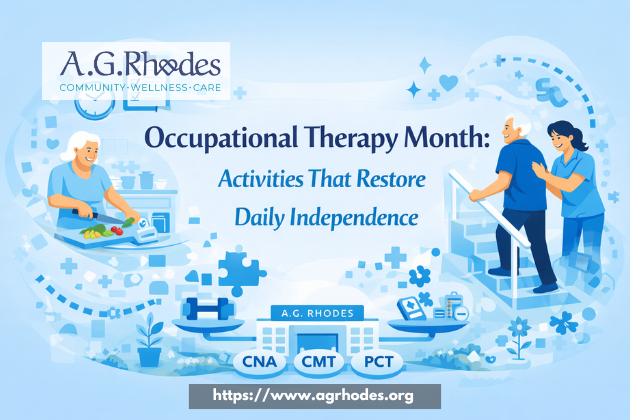
 Occupational Therapy Month highlights how targeted, everyday activities—like dressing, cooking, and mobility exercises—help seniors and recovering patients regain independence. Occupational therapists use personalized, goal-driven strategies to improve strength, coordination, and confidence, ultimately enabling safer, more independent living at home or in care communities.
Occupational Therapy Month celebrates the role of occupational therapy in restoring independence through practical, daily activities. By focusing on functional skills like bathing, dressing, and meal preparation, occupational therapists help individuals rebuild physical strength, cognitive ability, and confidence—empowering them to safely perform essential tasks and maintain a higher quality of life.
What Is Occupational Therapy and Why Does It Matter
Occupational therapy (OT) is a healthcare discipline focused on helping individuals regain the ability to perform meaningful daily activities—also known as Activities of Daily Living (ADLs). These include essential tasks such as eating, dressing, bathing, and mobility.
During Occupational Therapy Month, healthcare providers emphasize the importance of OT in:
- Post-surgical recovery
- Stroke rehabilitation
- Chronic disease management
- Aging in place
While many people associate OT with physical rehabilitation, its true value lies in task-specific retraining—helping patients relearn how to do everyday tasks in adaptive ways, not just rebuilding strength.
Key Activities That Restore Daily Independence
1. Activities of Daily Living (ADLs)
Occupational therapists focus on rebuilding independence in:
- Dressing (adaptive clothing techniques)
- Bathing (use of grab bars and shower chairs)
- Grooming (fine motor skill retraining)
Example: A patient recovering from a stroke may relearn how to button a shirt using one-handed techniques.
2. Functional Mobility Exercises
Mobility is foundational to independence. OT interventions include:
- Safe transfer techniques (bed to chair)
- Balance and coordination drills
- Use of assistive devices (walkers, canes)
OT differs from physical therapy by integrating mobility into real-life contexts—like navigating a kitchen rather than just walking in a hallway.
3. Cognitive Skill Rehabilitation
Occupational therapy also addresses cognitive challenges:
- Memory exercises (routine-building tools)
- Problem-solving tasks
- Attention and sequencing activities
Example Activities:
- Creating a daily checklist
- Cooking simple recipes to improve sequencing
- Medication management training
4. Home Safety and Environmental Modifications
A major focus of OT is reducing fall risk and improving safety at home.
Common recommendations:
- Installing grab bars in bathrooms
- Improving lighting in hallways
- Removing trip hazards like loose rugs
Research shows that environmental modifications combined with behavioral training reduce fall risk more effectively than either approach alone.
5. Instrumental Activities of Daily Living (IADLs)
Below are more complex tasks necessary for independent living:
- Cooking and meal preparation
- Managing finances
- Shopping and transportation
Example:
An occupational therapist may simulate grocery shopping to help a patient rebuild planning and endurance skills.
Comparison: OT Activities vs. Outcomes
| Activity Type | Skills Improved | Independence Outcome |
| ADL Training | Fine motor skills, coordination | Ability to dress and bathe independently |
| Mobility Exercises | Strength, balance | Reduced fall risk, safer movement |
| Cognitive Rehabilitation | Memory, attention | Improved decision-making and routines |
| Home Modifications | Environmental awareness | Safer living conditions |
| IADL Training | Executive functioning | Ability to live independently at home |
How Occupational Therapy Supports Aging in Place
Aging in place is a priority for many seniors, and occupational therapy plays a critical role in making it possible.
Key benefits include:
- Reduced hospital readmissions
- Increased confidence in daily tasks
- Improved mental health and reduced isolation
Studies show that seniors who receive occupational therapy interventions are significantly more likely to remain in their homes longer compared to those who do not.
Why Occupational Therapy Month Matters
Occupational Therapy Month is more than awareness—it’s a reminder that independence is not lost forever. With the right interventions, individuals can regain control over their daily lives.
OT is not just about recovery—it’s about restoring dignity, autonomy, and quality of life.
Experience Personalized Occupational Therapy at A.G. Rhodes
At A.G. Rhodes, occupational therapy is integrated into a holistic care model designed to help residents thrive.
Why choose A.G. Rhodes:
- Personalized therapy plans tailored to each individual
- Skilled therapists specializing in geriatric care
- Supportive environments focused on independence and dignity
Schedule a tour today to see how A.G. Rhodes helps residents regain independence through expert occupational therapy.
Contact our care team to learn more about therapy programs and rehabilitation services.
FAQ
What is the main goal of occupational therapy?
The main goal of occupational therapy is to help individuals regain the ability to perform daily activities independently and safely.
What activities are used in occupational therapy?
Occupational therapy uses activities like dressing, cooking, mobility exercises, and cognitive tasks to improve functional independence.
Who benefits from occupational therapy?
Seniors, stroke survivors, post-surgical patients, and individuals with chronic conditions benefit most from occupational therapy.
How does occupational therapy improve independence?
It improves independence by strengthening physical, cognitive, and adaptive skills needed for everyday tasks.
Can occupational therapy help prevent falls?
Yes, occupational therapy reduces fall risk through balance training, home modifications, and safety education.