

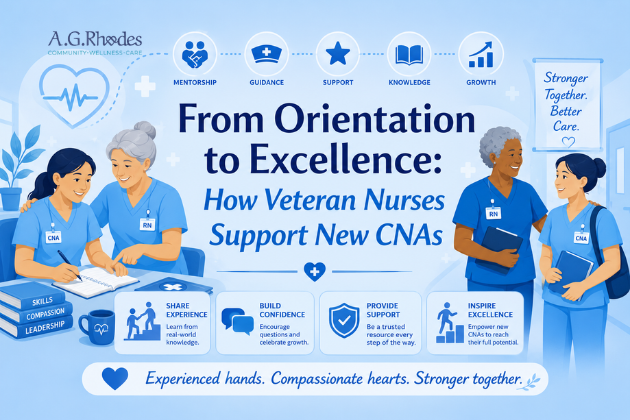
 The quality of care residents receive often depends on the strength of the team providing it. At A.G. Rhodes, experienced nurses play a vital role in mentoring newly hired Certified Nursing Assistants (CNAs), helping them develop clinical skills, confidence, compassion, and professionalism. This mentorship-driven approach strengthens senior care, improves resident outcomes, and provides families with greater peace of mind.
Veteran nurses help new CNAs succeed by providing hands-on training, clinical guidance, emotional support, and real-world coaching during the onboarding process. Their mentorship ensures consistent, compassionate, and high-quality senior care while helping new caregivers develop the skills needed to confidently support residents and rehabilitation patients.
Why Mentorship Matters in Senior Care
When families entrust a loved one to a rehabilitation or skilled nursing community, they want reassurance that every caregiver is knowledgeable, compassionate, and prepared for the challenges of daily resident care.
While classroom education provides an important foundation, many caregiving skills are learned through experience. That’s where veteran nurses make an extraordinary difference.
Experienced nurses serve as mentors, teachers, and role models for newly hired CNAs. Through daily coaching and collaboration, they help bridge the gap between training and real-world caregiving.
This mentorship approach creates a stronger care team and elevates the quality of senior care residents receive every day.
The Critical Role of CNAs in Resident Care
Certified Nursing Assistants are often the caregivers who spend the most time with residents. They assist with:
- Activities of daily living
- Mobility and transfers
- Personal hygiene
- Meal assistance
- Observation and reporting
- Emotional support and companionship
Because CNAs have frequent interactions with residents, they are often the first to notice changes in:
- Physical health
- Mobility
- Appetite
- Mood
- Cognitive function
These observations allow nurses and healthcare teams to respond quickly and appropriately.
How Veteran Nurses Guide New CNAs
1. Providing Hands-On Clinical Training
Orientation is only the beginning of a CNA’s professional development.
Veteran nurses help new team members learn how to:
- Safely transfer residents
- Prevent falls
- Identify early warning signs of illness
- Practice infection prevention
- Document observations accurately
- Respond appropriately to emergencies
This real-time guidance helps new CNAs build confidence while ensuring resident safety remains the highest priority.
2. Teaching the “Why” Behind Care Decisions
One of the most valuable aspects of mentorship is helping new CNAs understand the reasoning behind care plans.
Experienced nurses explain:
- Why repositioning prevents pressure injuries
- How hydration impacts recovery
- Why medication timing matters
- How rehabilitation goals support independence
Understanding the purpose behind care tasks encourages CNAs to become more engaged and proactive caregivers.
3. Building Confidence Through Support
Starting a new healthcare role can be overwhelming.
New CNAs often face challenges such as:
- Learning unfamiliar procedures
- Managing multiple responsibilities
- Communicating with families
- Supporting residents with complex medical needs
Veteran nurses provide encouragement, constructive feedback, and reassurance during this transition period.
This supportive environment helps new caregivers develop confidence while reducing stress and burnout.
4. Modeling Compassionate Care
Technical skills are essential, but compassion is equally important.
Residents and families remember how caregivers make them feel.
Experienced nurses demonstrate how to:
- Listen actively
- Show empathy
- Preserve dignity
- Respect resident preferences
- Communicate during difficult situations
These lessons help new CNAs understand that exceptional senior care involves both clinical excellence and human connection.
The Mentorship Advantage: What Families Notice
Families may not see the behind-the-scenes training that occurs every day, but they often notice the results.
When mentorship is a priority, residents benefit from:
| Mentorship Outcome | Resident Benefit |
| Better communication | Stronger relationships and trust |
| Improved CNA confidence | More consistent care |
| Enhanced clinical awareness | Earlier detection of health changes |
| Stronger teamwork | Better coordination of services |
| Reduced staff turnover | Greater continuity of care |
| Ongoing education | Higher quality outcomes |
These benefits contribute to a safer, more supportive environment for residents recovering from surgery, illness, stroke, or injury.
Supporting Rehabilitation Success Through Teamwork
For individuals recovering after hospitalization, teamwork between nurses and CNAs becomes especially important.
Short-term rehabilitation residents often require:
- Mobility assistance
- Pain management support
- Monitoring during recovery
- Therapy coordination
- Encouragement to achieve rehabilitation goals
Veteran nurses help new CNAs understand how their daily interactions directly impact recovery outcomes.
For example, a CNA who notices changes in strength, balance, appetite, or mood can quickly alert nursing staff, allowing early intervention when needed.
This collaborative approach supports successful rehabilitation and helps residents regain independence more effectively.
A Culture of Learning Benefits Everyone
The strongest healthcare organizations understand that mentorship isn’t a one-time event.
Continuous learning creates:
- Better caregivers
- Stronger teams
- Higher resident satisfaction
- Improved clinical outcomes
- Greater staff engagement
At A.G. Rhodes, experienced nurses help foster a culture where knowledge is shared, questions are welcomed, and professional growth is encouraged.
This commitment to excellence helps ensure residents receive compassionate, high-quality senior care from caregivers who are supported at every stage of their careers.
Why Mentorship Improves Family Confidence
Many discussions about CNA training focus on employee development. However, one often-overlooked benefit is the impact mentorship has on families.
When caregivers receive strong guidance from experienced nurses, families are more likely to experience:
- Consistent communication
- Greater transparency
- Faster responses to concerns
- Increased trust in the care team
- Confidence in rehabilitation progress
In other words, mentorship doesn’t only strengthen caregivers—it strengthens the family’s experience as well.
For adult children navigating difficult healthcare decisions, knowing that new caregivers are being actively supported by seasoned nurses can provide meaningful peace of mind.
Discover Compassionate Short-Term Rehabilitation at A.G. Rhodes
Recovering from surgery, illness, stroke, or injury requires expert care and a dedicated team working together to support every step of the healing journey.
At A.G. Rhodes, our experienced nurses, therapists, and caregivers collaborate to deliver exceptional short-term rehabilitation services designed to help residents regain strength, restore independence, and return home safely whenever possible.
If your loved one needs skilled rehabilitation and compassionate senior care after a hospital stay, contact A.G. Rhodes today to learn more about our short-term rehabilitation programs and how our experienced care team can support a successful recovery.
Frequently Asked Questions
What role do veteran nurses play in CNA training?
Veteran nurses provide hands-on instruction, coaching, supervision, and mentorship to help new CNAs develop clinical and caregiving skills.
Why is mentorship important in senior care?
Mentorship improves caregiver confidence, strengthens clinical skills, enhances resident safety, and promotes more consistent care.
How does CNA mentorship benefit residents?
Residents benefit from better communication, improved care quality, earlier recognition of health changes, and stronger caregiver relationships.
Can mentorship improve rehabilitation outcomes?
Yes. Well-trained CNAs work closely with nurses and therapists to support recovery goals, monitor progress, and encourage resident participation.
Does mentorship help reduce caregiver burnout?
Yes. Supportive coaching and ongoing guidance help new caregivers build confidence and adapt more successfully to their roles.