

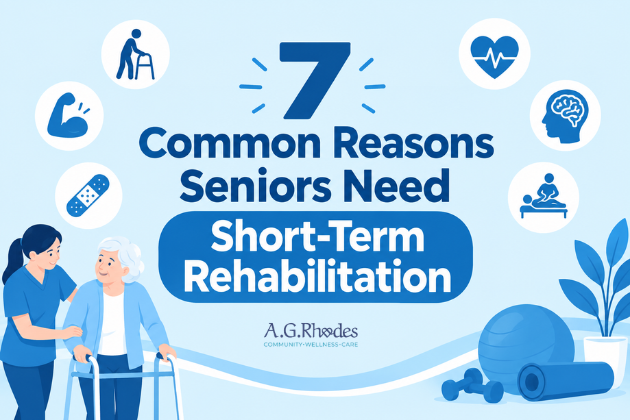
 Short-term rehabilitation can be an important part of recovery for older adults following an illness, injury, surgery, or hospitalization. When a senior is not quite ready to return home but does not necessarily need permanent residential care, short-term rehabilitation can provide a structured bridge between hospital care and greater independence.
At A.G. Rhodes, we understand that every older adult has different medical conditions, abilities, goals, and circumstances. The need for rehabilitation depends on an individual’s condition and care plan, which should be determined by qualified healthcare professionals.
In many situations, rehabilitation focuses on helping older adults regain strength, improve mobility, rebuild confidence, and safely resume everyday activities.
What Is Short-Term Rehabilitation for Seniors?
Short-term rehabilitation is a temporary period of skilled care and therapy designed to help an individual recover after a medical event.
Depending on the person’s needs, rehabilitation may include physical therapy, occupational therapy, skilled nursing care, and other supportive services.
The purpose is not simply to provide a place for someone to stay after leaving the hospital. A comprehensive rehabilitation program is designed around specific recovery goals.
For one senior, the primary objective may be improving walking ability after surgery. For another, it may involve relearning how to safely perform everyday activities following a stroke or serious illness.
The rehabilitation team evaluates the individual’s abilities and develops an appropriate plan based on their condition, physician recommendations, and functional goals.
7 Common Situations When a Senior May Need Short-Term Rehabilitation
Several situations can result in an older adult needing rehabilitation before returning home.
1. After Major Surgery
Surgery can temporarily affect an older adult’s strength, mobility, balance, and ability to perform everyday activities.
Procedures involving the hip, knee, spine, or other parts of the body may require a period of rehabilitation before a person can safely manage at home.
For example, following joint replacement surgery, an older adult may need help improving strength, mobility, balance, and the ability to perform activities such as getting out of bed, walking, bathing, dressing, or navigating stairs.
Short-term rehabilitation can provide a structured environment where the individual can work with therapists while receiving appropriate nursing support.
The goal is to help the senior progress safely toward the functional abilities needed for the next stage of recovery.
2. After a Fall or Serious Injury
Falls are a significant concern for older adults because they can result in fractures, mobility limitations, and loss of confidence.
Even when an injury has been medically treated, an older adult may not immediately return to their previous level of function.
A period of rehabilitation may help address:
- Muscle weakness
- Reduced balance
- Difficulty walking
- Limited range of motion
- Reduced endurance
- Fear of falling
- Difficulty performing everyday activities
Rehabilitation can also help identify functional challenges that may need to be addressed before the individual returns home.
Depending on the circumstances, therapists may work on safe transfers, walking techniques, strengthening exercises, balance, and activities of daily living.
3. Following a Stroke
A stroke can affect movement, balance, communication, coordination, and the ability to perform everyday tasks.
Recovery varies considerably from person to person. Some older adults may require intensive support after hospitalization before they can safely return home.
Rehabilitation may focus on helping the individual regain or improve functional abilities affected by the stroke.
Physical therapy may address movement, strength, balance, and mobility. Occupational therapy may focus on everyday activities and adapting to changes in physical or cognitive function.
The rehabilitation process can also help families understand what support their loved one may need after discharge.
Stroke rehabilitation is highly individualized, and the appropriate setting depends on the person’s medical stability, functional needs, and treatment recommendations.
4. After a Serious Illness or Hospitalization
A prolonged illness or hospital stay can leave an older adult significantly weaker than before.
This decline in strength and endurance is sometimes referred to as deconditioning. An older adult who was previously independent may suddenly need assistance with walking, bathing, dressing, transferring, or other daily activities.
Short-term rehabilitation can provide an opportunity to rebuild physical capacity under professional supervision.
The recovery process may involve gradually increasing activity, improving endurance, strengthening muscles, and practicing functional movements.
For families, rehabilitation can provide additional time for the older adult to regain abilities before attempting to manage independently at home.
5. After a Joint Replacement or Orthopedic Procedure
Hip and knee replacement surgeries are common examples of procedures that may require rehabilitation.
Although joint replacement can improve mobility and reduce pain over the long term, recovery requires time and active participation.
A rehabilitation program may help an older adult work toward improved:
- Walking ability
- Leg strength
- Balance
- Flexibility
- Endurance
- Transfer skills
- Ability to complete daily activities
The rehabilitation team can also reinforce safe movement techniques and exercises recommended as part of recovery.
Because every surgical recovery is different, the appropriate rehabilitation plan should follow the individual’s medical and therapy recommendations.
6. When an Older Adult Is Having Difficulty With Daily Activities
Sometimes rehabilitation becomes necessary because an older adult experiences a noticeable decline in functional independence.
An individual may be medically stable but struggle with everyday tasks that were previously routine.
These challenges may include:
- Getting in and out of bed
- Walking safely
- Using the bathroom
- Bathing
- Dressing
- Preparing meals
- Moving between rooms
- Using stairs
- Transferring from a chair to a standing position
Occupational and physical therapy can address different aspects of functional independence.
The objective may be to help the individual regain sufficient ability to perform these tasks more safely or determine what adaptations and assistance are necessary for the next stage of care.
7. When Returning Home Immediately Would Not Be Safe
One of the clearest reasons an older adult may need short-term rehabilitation is that they are not yet ready to safely return home.
A senior may have been discharged from the hospital medically but still have significant functional limitations.
For example, they may require assistance with transfers, walking, bathing, or other essential activities.
Returning home too soon can create challenges if the necessary support, equipment, or supervision is not available.
Short-term rehabilitation can provide a transitional period in which the individual receives skilled support while working toward appropriate recovery goals.
Signs a Senior May Benefit From Rehabilitation
Families may wonder how to recognize when rehabilitation could be appropriate.
Potential signs include a noticeable decline in mobility or independence following an illness, surgery, injury, or hospitalization.
A senior may:
- Have difficulty walking compared with their previous ability
- Require more assistance with everyday activities
- Experience significant weakness
- Have difficulty maintaining balance
- Need help transferring between a bed, chair, or toilet
- Become easily fatigued during routine activities
- Have difficulty safely managing stairs
- Need therapy to regain functional abilities
- Require additional support before returning home
These signs do not automatically mean that short-term rehabilitation is necessary. A physician and qualified care team should determine the appropriate level of care based on the individual’s medical and functional needs.
How Short-Term Rehabilitation Helps Seniors Regain Independence
The primary purpose of rehabilitation is often to help an older adult regain as much safe independence as possible.
Rehabilitation is typically goal-oriented.
Rather than simply providing assistance with daily activities, therapists may work with the individual to improve the abilities required to perform those activities.
For example, instead of permanently helping someone transfer from a chair, a therapist may work on strength, balance, coordination, and movement techniques that could allow the individual to complete the transfer more independently.
This distinction is important.
The goal of rehabilitation is to support recovery and functional improvement rather than create unnecessary dependence.
Physical Therapy for Older Adults
Physical therapy can play an important role in senior rehabilitation.
Depending on individual needs, physical therapy may address:
- Strength
- Balance
- Walking
- Mobility
- Endurance
- Coordination
- Range of motion
- Transfers
- Fall-risk reduction
Therapy activities are adapted to the individual’s condition and abilities.
For an older adult recovering from surgery, therapy may focus on restoring mobility. For someone recovering from an illness, the emphasis may initially be on rebuilding strength and endurance.
The rehabilitation plan should always reflect the person’s medical status and treatment goals.
Occupational Therapy and Everyday Independence
Occupational therapy focuses on helping people participate in everyday activities.
For older adults, this can involve practicing activities such as dressing, bathing, grooming, eating, transferring, and other tasks required for daily life.
Occupational therapists may also identify ways to make activities safer or easier.
In some circumstances, they may recommend adaptive techniques or equipment based on the individual’s needs.
This type of therapy is especially valuable because recovery is ultimately about more than walking farther or becoming stronger—it is also about being able to participate in everyday life.
The Importance of Family Involvement During Rehabilitation
Family support can be an important part of an older adult’s recovery journey.
When family members remain involved, they can provide encouragement while also learning more about the senior’s capabilities and ongoing needs.
Family members may also provide useful information about the person’s normal routines, home environment, preferences, and previous level of independence.
As discharge approaches, family involvement can become particularly important.
The family may need to understand:
- What activities the senior can safely perform
- What assistance is still required
- What equipment may be necessary
- How medications should be managed
- What follow-up appointments are needed
- What home modifications may be appropriate
- What warning signs should be communicated to healthcare providers
A rehabilitation facility near family can make regular visits and communication more practical.
Why Location Matters When Choosing a Senior Rehab Facility
When searching for short-term rehabilitation near me, families often consider location alongside quality of care.
A convenient location can make it easier for family members to visit regularly. Frequent visits can provide emotional support and allow families to remain connected with the care team.
Location may also matter when families are preparing for discharge.
If the rehabilitation facility is near the individual’s home, family members may have greater opportunities to participate in discussions about the transition and understand what will be required after the senior returns home.
For families in the Atlanta area, A.G. Rhodes offers senior care services in communities serving Grant Park, near the Decatur area, and Marietta, providing options for families seeking accessible senior care and rehabilitation.
What to Look for in a Short-Term Rehabilitation Facility
Choosing a rehabilitation facility is an important decision. Families should consider more than location.
Skilled Rehabilitation Services
Ask what therapy services are available and whether they match the individual’s needs.
Individualized Care
Each senior should receive care based on their unique condition, abilities, goals, and circumstances.
Qualified Care Professionals
Learn about the professionals involved in rehabilitation and how the care team communicates about progress.
Family Communication
Ask how families receive updates and participate in care planning.
Discharge Planning
A strong rehabilitation process should consider what happens after the rehabilitation stay, including the individual’s anticipated needs at home.
Quality of Life
Recovery should include attention to emotional well-being, social engagement, dignity, and meaningful daily experiences.
Location and Accessibility
Consider whether family members can realistically visit as often as they would like.
How Families Can Prepare for a Senior’s Rehabilitation Stay
Families can help by providing relevant information about the older adult’s usual abilities and routines.
It can be useful to communicate information about:
- Previous mobility level
- Typical daily routines
- Home layout
- Stairs or other potential barriers
- Existing assistive devices
- Medication routines
- Family support available at home
- Important preferences and concerns
Families can also ask the rehabilitation team about expected goals and how progress will be evaluated.
Most importantly, family members can provide consistent encouragement without putting unrealistic pressure on the recovering senior.
Recovery takes time, and progress can vary from one person to another.
How Long Does Short-Term Rehabilitation Take?
There is no single rehabilitation timeline that applies to every older adult.
The length of stay depends on factors such as the individual’s diagnosis, medical condition, functional limitations, progress, rehabilitation goals, and ability to transition safely to the next level of care.
Some seniors may make significant progress within a relatively short period, while others require more time and support.
The care team can provide a more individualized assessment based on the person’s circumstances.
When Is a Senior Ready to Return Home?
Returning home is an important rehabilitation milestone, but readiness should be based on safety and functional ability rather than simply the passage of time.
The care team may consider whether the individual can perform necessary activities safely, what assistance remains necessary, and whether appropriate support is available at home.
Discharge planning may involve coordination with family members, physicians, therapists, home health professionals, or other providers as appropriate.
The goal is to create a transition plan that supports continued recovery while reducing unnecessary risks.
Supporting Recovery Beyond the Rehabilitation Facility
Rehabilitation does not necessarily end when a senior leaves the facility.
Depending on the individual’s needs, continued exercises, follow-up appointments, home health services, outpatient therapy, or other support may be recommended.
Families can help by encouraging adherence to the recommended care plan and making the home environment as safe and accessible as possible.
Continued support can help older adults maintain the progress they achieved during rehabilitation.
A.G. Rhodes: Supporting Seniors Through Recovery
At A.G. Rhodes, we understand that recovery can be a significant transition for older adults and their families.
Our nonprofit senior care organization is committed to providing compassionate, person-centered/person-directed care that respects each individual’s dignity and unique needs.
For seniors who require rehabilitation after an illness, injury, surgery, or hospitalization, the right care environment can provide valuable support while they work toward their recovery goals.
We also recognize the importance of family involvement. Keeping loved ones connected throughout rehabilitation can provide encouragement and help families better understand the recovery process.
If you are looking for short-term rehabilitation for a senior in the Atlanta area, we invite you to learn more about A.G. Rhodes and our approach to senior care.
Contact A.G. Rhodes today to explore rehabilitation options and learn how we can support your loved one’s journey toward greater independence.
Take the Next Step Toward Recovery
When an older adult is not quite ready to return home after an illness, injury, surgery, or hospitalization, short-term rehabilitation can provide an important bridge between hospital care and greater independence.
The right rehabilitation environment combines appropriate clinical support with individualized therapy, compassionate care, family involvement, and thoughtful discharge planning.
For families, choosing a facility close to home can make it easier to remain involved. For seniors, consistent encouragement and professional support can help make the recovery process more manageable.
Contact A.G. Rhodes today to learn more about short-term rehabilitation and discover how our team can support your loved one’s recovery, dignity, and quality of life.
Frequently Asked Questions About Short-Term Rehabilitation for Seniors
When does a senior need short-term rehabilitation?
A senior may need short-term rehabilitation after surgery, injury, illness, hospitalization, or another medical event that causes a temporary decline in strength, mobility, endurance, or independence. A healthcare professional should determine whether rehabilitation is appropriate.
What is the purpose of short-term rehabilitation?
The purpose is to help an individual improve functional abilities and work toward a safe transition to the next level of care. Depending on the person’s needs, rehabilitation may focus on mobility, strength, balance, endurance, and everyday activities.
Does every senior who leaves the hospital need rehabilitation?
No. Some older adults can safely return home after hospitalization, while others require additional skilled care or rehabilitation. The appropriate setting depends on the individual’s medical and functional condition.
How do I know if my parent is ready to return home after hospitalization?
A care team can evaluate the individual’s mobility, ability to perform daily activities, medical needs, and available support at home. If significant assistance is still required, rehabilitation or another level of care may be recommended.
What types of therapy are provided in senior rehabilitation?
Depending on the individual’s needs, rehabilitation may include physical therapy and occupational therapy, along with skilled nursing and other supportive services.
How long does senior rehabilitation usually last?
The length of a rehabilitation stay varies according to the individual’s condition, progress, goals, and care requirements. There is no universal timeline.
Can family members visit during short-term rehabilitation?
Visitation policies vary by facility. Regular family involvement can provide emotional support and help relatives stay informed about their loved one’s recovery.
Why should I choose a rehabilitation facility near my home?
A nearby facility can make regular family visits more convenient and may make it easier for relatives to participate in care discussions and discharge planning.
What is the difference between short-term rehabilitation and long-term care?
Short-term rehabilitation generally focuses on recovery and improving functional abilities after a medical event. Long-term care is designed for individuals who require ongoing assistance or skilled nursing services.
Is rehabilitation only for seniors recovering from surgery?
No. Rehabilitation may also be appropriate following illness, injury, hospitalization, stroke, significant deconditioning, or a decline in functional abilities.
Can rehabilitation help a senior regain independence?
Rehabilitation can help eligible individuals work toward improving strength, mobility, balance, endurance, and everyday functional skills. The amount of recovery varies according to the individual’s condition and circumstances.
Where can I find short-term senior rehabilitation near Grant Park, Decatur, or Marietta?
A.G. Rhodes provides senior care services in the Atlanta area, including communities serving Grant Park, the Decatur area, and Marietta. Families can contact A.G. Rhodes to learn more about available rehabilitation and senior care options.