

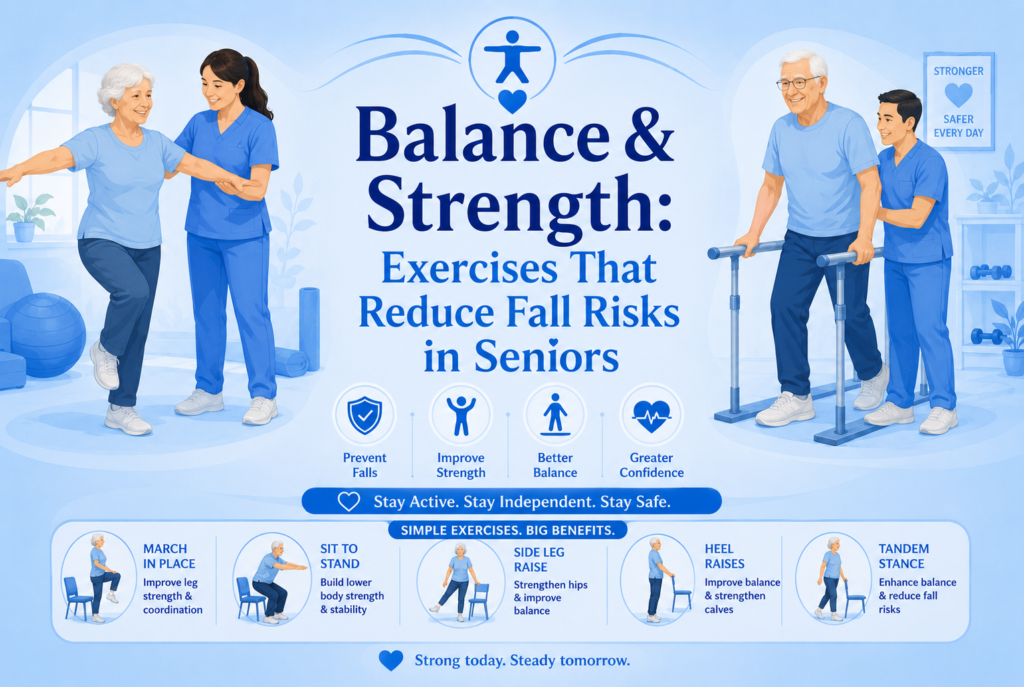
 Falls are one of the most significant safety concerns for older adults. As we age, changes in balance, muscle strength, flexibility, vision, coordination, and reaction time can make it harder to recover from a stumble or navigate everyday obstacles safely. The good news is that regular physical activity can help older adults maintain the abilities they need to move confidently and safely.
We can reduce fall risks in seniors by incorporating exercises that specifically target lower-body strength, balance, coordination, flexibility, and functional movement. These exercises do not need to be complicated or strenuous. When performed consistently and appropriately for an individual’s abilities, simple movements can make everyday activities such as standing from a chair, walking, climbing stairs, and getting in and out of bed easier and safer.
At A.G. Rhodes, we recognize that maintaining mobility and independence is an important part of healthy aging. Exercise is one component of a broader approach to helping older adults remain active, confident, and engaged in daily life.
Why Balance and Strength Matter for Fall Prevention
Falls often occur when an older adult encounters a situation that challenges their ability to maintain stability. A slippery surface, uneven pavement, a misplaced object, or a sudden change in direction can require quick adjustments.
Muscle strength and balance work together. Strong legs and hips help support the body, while good balance allows us to maintain control when our position changes. Flexibility and coordination also contribute to safe movement.
Lower-body strength is particularly important because many everyday activities depend on the muscles around the hips, thighs, knees, and ankles. Weakness in these areas can make it more difficult to rise from a chair, step over an obstacle, or regain stability after a misstep.
Balance exercises, meanwhile, help older adults practice maintaining control while standing and moving. Over time, appropriate training can support greater confidence during everyday activities.
1. Sit-to-Stand Exercises
The sit-to-stand exercise is one of the most practical strength exercises for seniors because it closely resembles an activity we perform throughout the day.
To perform the exercise safely:
- Sit toward the front of a sturdy chair.
- Place both feet firmly on the floor.
- Lean forward slightly while keeping the back relatively straight.
- Push through the feet and stand up slowly.
- Pause briefly while standing.
- Slowly lower back into the chair.
We can begin with a small number of repetitions and gradually increase them as strength improves.
This movement primarily works the thigh and hip muscles, which are important for standing, walking, and maintaining functional independence.
If an older adult has difficulty completing the movement without using their arms, they can use the chair’s armrests or another stable support as appropriate.
2. Heel Raises for Stronger Ankles and Calves
Heel raises are a simple exercise that can help strengthen the calf and ankle muscles.
While standing behind a sturdy chair or another stable surface:
- Place both feet approximately hip-width apart.
- Hold the support lightly.
- Slowly raise the heels until standing on the balls of the feet.
- Pause for a moment.
- Lower the heels slowly and with control.
Strong ankles can contribute to stability during walking and standing. Performing the movement slowly also encourages better control rather than relying on momentum.
Because balance can be challenged during this exercise, we should always prioritize safety and use appropriate support when necessary.
3. Side Leg Raises
Side leg raises target muscles around the hips that contribute to stability while standing and walking.
To perform them:
- Stand behind a sturdy chair.
- Hold the chair for support.
- Keep the upper body upright.
- Slowly move one leg outward to the side.
- Avoid leaning the torso in the opposite direction.
- Return the leg slowly to its starting position.
- Repeat with the other leg.
Strong hip muscles can help support stable movement and make certain everyday activities easier.
4. Heel-to-Toe Walking
Heel-to-toe walking is a balance exercise that challenges coordination and stability.
We can practice by walking slowly along a clear, unobstructed area. Place the heel of one foot directly or nearly directly in front of the toes of the opposite foot, then repeat with the other foot.
A countertop, sturdy railing, or another appropriate support should be nearby when needed.
This exercise should be performed slowly. The goal is controlled movement, not speed.
Older adults who have significant balance difficulties should practice this type of activity with appropriate supervision rather than attempting it independently.
5. Marching in Place
Marching in place can help older adults practice controlled weight shifting and strengthen the muscles involved in walking.
While standing near a stable support, lift one knee gently, lower it, and then lift the opposite knee. The movement can be performed slowly and deliberately.
For individuals who cannot safely stand for extended periods, a healthcare or rehabilitation professional may recommend an appropriate seated variation.
6. Ankle Movement and Flexibility Exercises
Maintaining mobility in the ankles can support comfortable walking and functional movement.
Simple ankle exercises can include gently pointing and flexing the feet while seated. Ankle circles may also be appropriate for some older adults.
These movements are generally less demanding than standing balance exercises and can be incorporated into an overall movement routine.
However, we should avoid forcing a joint beyond a comfortable range. Any exercise that causes significant pain should be stopped and discussed with an appropriate healthcare professional.
7. Step-Up Exercises
Step-up exercises can strengthen the legs while practicing a movement that resembles climbing stairs or stepping onto a curb.
Because this exercise involves an elevated surface and requires balance, safety is especially important.
A sturdy, appropriately sized step and secure hand support should be used when recommended. Older adults should not attempt step-ups on unstable furniture or improvised surfaces.
A physical therapist or qualified exercise professional can help determine whether step-ups are appropriate and how they should be performed.
Combining Strength and Balance Exercises for Better Fall Prevention
We should not rely on a single exercise to address fall risk. A well-rounded exercise program can incorporate several components:
- Strength exercises for the legs and hips
- Balance exercises for stability and coordination
- Flexibility exercises for comfortable movement
- Walking or other aerobic activity for endurance
- Functional exercises that replicate everyday movements
Consistency is often more important than intensity. A manageable routine that an older adult can perform regularly may be more beneficial than an overly demanding program that becomes difficult to maintain.
How Often Should Seniors Exercise?
The appropriate amount and intensity of exercise varies according to an individual’s health, mobility, fitness level, medications, and physical limitations.
Older adults who are new to exercise should begin gradually. We can increase activity over time as tolerance and strength improve.
For seniors with chronic health conditions, a history of falls, significant weakness, dizziness, mobility limitations, or other concerns, it is important to consult a healthcare professional before beginning a new exercise program.
A physical therapist can also provide individualized exercises and modifications based on strength, balance, mobility, and fall risk.
Safety Tips for Senior Exercise
Exercise should improve confidence and physical function without creating unnecessary hazards.
We recommend several basic precautions:
- Exercise in a clear, well-lit area.
- Wear supportive footwear.
- Keep a sturdy support nearby when performing standing exercises.
- Avoid exercising on slippery surfaces.
- Start slowly and prioritize controlled movements.
- Take appropriate rest periods.
- Stop if an exercise causes significant pain, unusual shortness of breath, chest discomfort, severe dizziness, or other concerning symptoms.
- Use supervision when an older adult has substantial balance or mobility difficulties.
We should also remember that fall prevention extends beyond exercise. Adequate lighting, appropriate footwear, medication reviews, vision care, assistive devices when needed, and reducing household hazards can all contribute to a safer environment.
Exercise and Maintaining Senior Independence
Fall prevention is about more than avoiding injuries. Maintaining strength and balance can support an older adult’s ability to participate in the activities that make daily life meaningful.
Being able to stand independently, walk safely, move around the home, participate in social activities, and complete routine tasks can contribute to a greater sense of independence.
Regular movement may also help seniors remain engaged in their communities and preserve physical abilities that support quality of life.
We should approach exercise as part of healthy aging rather than simply as a response to declining mobility. Starting appropriate strength and balance activities earlier can help older adults maintain physical function as they age.
When Professional Support May Be Appropriate
Some seniors require more individualized guidance than a general exercise routine can provide.
Professional assessment may be particularly appropriate for older adults who have experienced a recent fall, demonstrate significant difficulty walking, use a mobility aid, experience frequent dizziness, or have substantial weakness.
A healthcare professional or physical therapist can assess movement and recommend exercises that match the individual’s capabilities.
For seniors living in a residential care setting, caregivers and care teams can also help encourage appropriate activity while taking individual safety considerations into account.
A.G. Rhodes Can Help Support Healthy Aging
At A.G. Rhodes, we understand that supporting older adults involves more than meeting their basic care needs. We focus on creating an environment where seniors can maintain dignity, engagement, and as much independence as possible.
Our senior care communities provide opportunities for residents to remain active and connected while receiving the level of support appropriate for their individual needs. We recognize that every older adult has different abilities, interests, and goals, so care should be approached with those individual needs in mind.
If you are exploring senior care options for yourself or a loved one, we invite you to learn more about A.G. Rhodes and discover how our communities can support healthy aging, connection, and quality of life.
Conclusion: Building Strength and Confidence as We Age
Fall prevention begins with understanding the importance of strength, balance, mobility, and a safe environment. Simple exercises such as sit-to-stands, heel raises, side leg raises, marching, and balance activities can help older adults practice the physical skills required for everyday movement.
We should remember that every senior has different abilities and health considerations. Exercise programs should therefore be adapted to the individual, with professional guidance when appropriate.
By combining regular physical activity with environmental safety, appropriate healthcare, good footwear, vision care, and individualized support, we can take meaningful steps toward reducing fall risks and helping seniors remain active and independent.
Frequently Asked Questions About Senior Exercises and Fall Prevention
What is the best exercise for seniors to prevent falls?
There is no single best exercise for every senior. A combination of strength, balance, flexibility, and functional exercises can provide a more comprehensive approach. Sit-to-stand exercises, heel raises, and supervised balance activities are examples that may be useful for many older adults.
Can exercise really reduce the risk of falls in older adults?
Regular physical activity can help address several factors associated with fall risk, including muscle weakness and impaired balance. A consistent, appropriately designed exercise program can support strength, coordination, mobility, and confidence.
How often should seniors do balance exercises?
Frequency should be based on an individual’s abilities and overall health. Older adults should follow an exercise routine that they can perform safely and consistently. Those with significant balance problems should seek professional guidance.
What exercises strengthen the legs for seniors?
Sit-to-stand exercises, heel raises, supported squats, leg raises, and appropriately supervised step-ups can help strengthen muscles used for standing and walking. The right exercises depend on an individual’s physical abilities.
Should seniors exercise if they have already experienced a fall?
A previous fall can be an important reason to address strength and balance, but seniors who have recently fallen should consider discussing exercise with a healthcare professional or physical therapist. An individualized assessment can help identify appropriate and safe activities.
What can families do besides exercise to prevent falls?
Families can help by keeping walking areas clear, improving lighting, addressing loose rugs and other hazards, encouraging appropriate footwear, arranging vision and medication reviews when needed, and ensuring mobility aids are properly fitted and used.
Are balance exercises safe for seniors with limited mobility?
Some balance exercises can be adapted for people with limited mobility, including seated exercises. However, seniors with significant mobility or balance challenges should receive individualized recommendations rather than attempting advanced standing exercises without appropriate support.
Can seniors exercise at home to improve balance and strength?
Yes, many exercises can be performed at home, provided the environment is safe and the exercises are appropriate for the individual’s abilities. A clear exercise area and stable support are particularly important for standing activities.
Why is leg strength important for fall prevention?
Strong leg muscles help support everyday movements such as standing, walking, turning, and climbing stairs. Maintaining lower-body strength can help older adults perform these movements with greater control and stability.
What should a senior do if an exercise causes pain or dizziness?
The exercise should be stopped, particularly if symptoms are significant or unusual. Persistent or concerning symptoms should be discussed with an appropriate healthcare professional before continuing the activity.